The Learning Pyramid Is Built on Sand
I know I promised I’d dig into adult learning theory in my next post, but as I started writing it, I realized I need to lay a bit more groundwork first, specifically around information processing theory (which I have yet to write about). So to tide you over in the meantime, here’s a quick post discussing a different learning myth you’ve probably come across. I present to you: the Learning Pyramid.
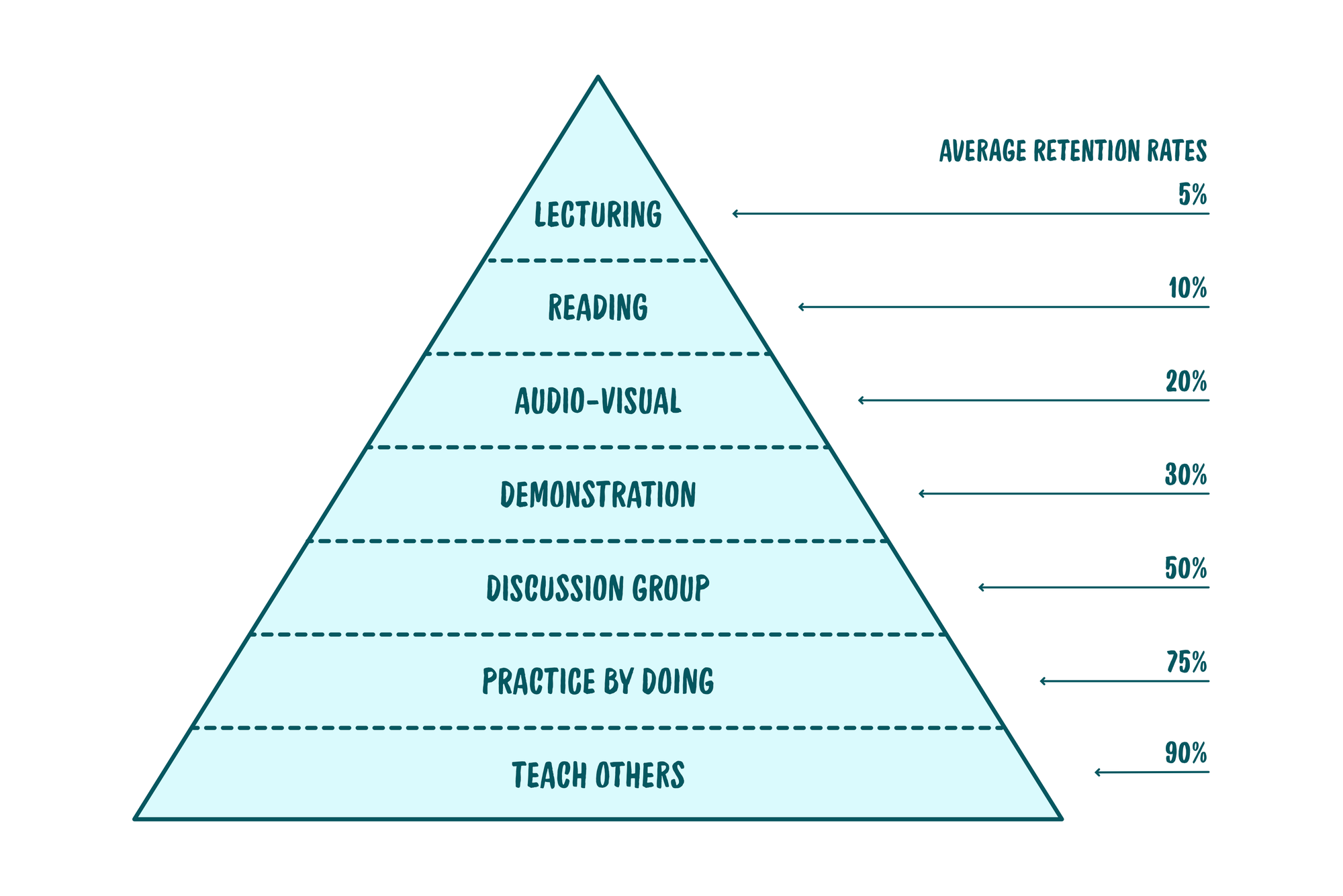
The lore of the Learning Pyramid is founded on the idea that we retain information in predictable percentages depending on how we learn it. “Passive” methods like reading or listening supposedly lead to low retention, while “active” methods like discussion, practice, or teaching others supposedly lead to much higher retention.
It’s appealing because it feels intuitive. I also feel like I remember things better when I explain them to someone else.
But once we start looking at this pyramid and its claims with a critical eye, it quickly becomes apparent that none of it holds up to scrutiny. Letrud (2012) lays out a helpful critique, and I have thrown in a few thoughts as well.
The Issues
- Teaching others is paradoxical. The “teaching others” category creates a bit of a paradox. In order to teach something well, you have to have learned it yourself first, right? And presumably you learned it through one (or more) of those supposedly “inferior” methods, like reading, listening, or watching. So how can we claim that teaching others is the best way to learn, if it depends entirely on the teacher having already learned the material through some other method?
- Statistics aren't that clean. As David Didau rightly points out, the average retention rates associated with the Learning Pyramid are clean multiples of five. Real-world data is never that tidy. So either the numbers are completely made up, or they’ve been rounded so heavily that they’re no longer accurate.
- The categories overlap. The tier categories are so loosely defined that they blur into each other. For example, let's consider a video, which most intuitively fits into the "audio-visual" category. But a video might include narration (basically a lecture - described as an "inferior" method of learning), on-screen text (which requires reading - another "inferior" method), and demonstrations (the next tier up from audio-visual) — all wrapped into one. So which category is this video supposed to fall into? It’s never really clear how these learning activities are being defined, or where one ends and another begins.
- How in the world do you design research to test this theory? Let’s imagine we’re the researchers trying to test the propositions of the Learning Pyramid. How on earth would we even design a study to isolate learning experiences into these neat little categories? Take “demonstration,” for example. How would we make sure participants learned only through a demonstration, without reading anything, without hearing an explanation, without discussing it with anyone afterward? In the real world, these activities almost always overlap. Also, how would we isolate the independent variable and control for all the inevitable confounding variables when the categories themselves are so loosely defined? It starts to feel practically impossible. But for this pyramid to exist, someone must have done it, so let's look at the methods they used!
Now, there have been plenty of spin-offs of this pyramid over the years, but the most popular version, the one most people are referring to when they say “the Learning Pyramid” comes from the NTL Institute. Theirs is the version represented in my illustration above.
If you reach out to them (as many curious researchers have, including Booth, 2011; Lalley & Miller, 2007; Letrud, 2012), you’ll typically get a response that looks something like this:
"Thanks for your interest in NTL Institute. We are happy to respond to your inquiry about The Learning Pyramid. It was developed and used by NTL Institute at our Bethel, Maine campus in the early sixties when we were still a part of the National Education Association's Adult Education Division.
While we believe it to be accurate, we no longer have- nor can we find the original research that supports the numbers. We get many inquiries every month about this- and many, many people have searched for the original research and have come up empty handed.
We know that in 1954 a similar pyramid with slightly different numbers appeared on p. 43 of a book called Audio-Visual Methods in Teaching, published by the Edgar Dale Dryden Press in New York however the Learning Pyramid as such seems to have been modified and remains attributed to NTL Institute."
So they claim that they once had research supporting their claims, but they lost it. It was at this point while I was doing my research on this topic where my brain did this:

So is this whole thing just completely made up? Well… sort of.
The Origins of the Pyramid
Letrud and Hernes (2018) do an excellent job of tracing the origins of the Learning Pyramid and untangling where it actually came from. I'll quickly summarize what they found.
The core idea that people remember only a little of what they read or hear but much more of what they say, or do appears to date back at least to the 1850s. These were rhetorical or common-sense claims, not backed by any research. In 1967, D.G. Treichler popularized the percentages of average retention rates and implied these numbers were backed by research but never provided any sources as proof. Later, these retention rates were fused with a misinterpretation of Edgar Dale’s (1954) Cone of Experience, creating the modern learning pyramid graphic that stands before you today. Letrud and Hernes conclude that the Learning Pyramid is a quasi-scientific myth that has survived for over 160 years, but has never been backed by empirical research.
So at the very least, we can say with a fair bit of confidence that the NTL Institute’s claim — that their Learning Pyramid is grounded in original research — is probably not true.
The Pyramid Isn't Aligned with Widely Accepted Learning Theories
The Learning Pyramid assumes that how you take in information — by reading or hearing — is the main thing that determines how much you’ll remember. Modern cognitive psychology rejects this view. In the well-known Atkinson–Shiffrin (1968) model of memory, what really determines retention isn’t the format of the input. Instead, other factors are far more influential like attention, how deeply you process the information, whether it makes sense to you, and how well it connects to what you already know.
Long-term memory doesn’t choose what information to store based on how it came in (whether you “heard” it or “saw” it). Information is stored based on meaning and how it connects to other ideas. The Learning Pyramid’s focus on ranking formats ignores decades of research showing that retention actually depends on factors like prior knowledge, depth of processing, the kind of rehearsal you do, context, and retrieval practice. In short, the Learning Pyramid treats learning like a simple input-output system, while modern memory science sees learning as active, constructive, and highly dependent on context.
David Didau points out that the real danger here isn’t just that the numbers are wrong. It’s that the Learning Pyramid quietly pushes a flawed theory of learning, one that prioritizes visible performance over genuine understanding. If we believe discussion automatically leads to retention, we may prioritize having learners talk about concepts before they actually understand the material. If we treat “teaching others” as the fast track to mastery, we risk asking students to explain ideas they don’t yet understand themselves. And this could end up short-changing learners in the long run.
References
Atkinson, R. C., & Shiffrin, R. M. (1968). Human memory: A proposed system and its control processes. In K. W. Spence & J. T. Spence (Eds.), The psychology of learning and motivation (Vol. 2, pp. 89–195). Academic Press.
Member discussion